
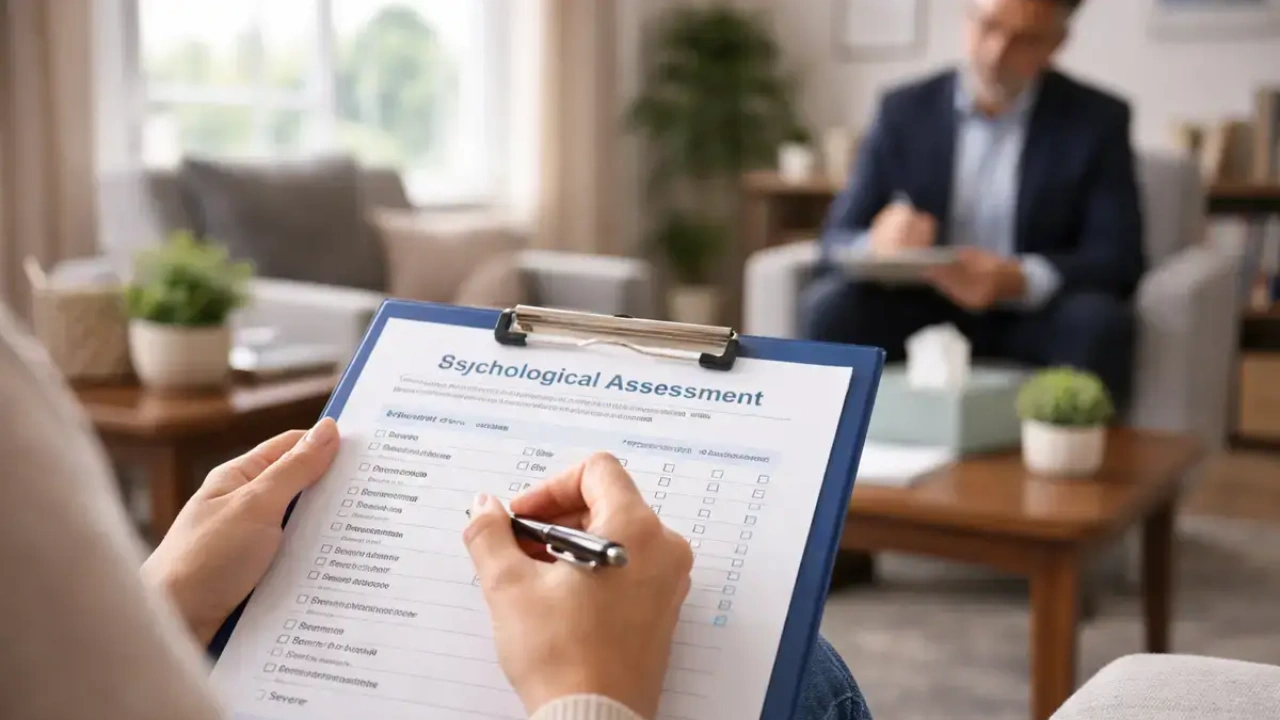
A psychological test is an assessment instrument developed to measure a particular psychological characteristic under standard conditions. Tests may provide information about attention, cognitive abilities, personality, mood, anxiety, development or behaviour. A score does not define the whole person and, in most situations, cannot establish a psychiatric diagnosis by itself.
Psychological assessment is broader than completing a questionnaire. The psychologist considers the referral question, personal history, observations, interview findings and, when appropriate, information from other sources. A test is one part of this process. Even a well-designed instrument can be misleading if used for the wrong purpose or interpreted outside its context.
What are psychological tests used for?
Testing can help examine a broad complaint systematically. It may contribute to understanding when attention difficulties occur, identifying relative strengths and needs across cognitive areas, or estimating the level of self-reported anxiety symptoms. Results can inform therapy planning, educational support or a decision to seek further assessment.
A measure may also establish a baseline and help monitor change. A difference in score does not always represent a true psychological change, however. Practice effects, motivation, sleep, medication and testing conditions may influence performance. Interpretation therefore requires professional judgement.
Testing and assessment are not the same
A psychological test is one instrument administered and scored according to specific rules. Psychological assessment is a decision-making process that may combine clinical interviews, tests, behavioural observation, developmental history, medical information and reports from family or teachers.
For example, one attention task is rarely sufficient to explain concentration problems. Sleep loss, anxiety, depression, learning difficulties, medication and environmental demands can produce similar complaints. Assessment compares alternative explanations rather than treating one score as the entire truth.
Types of psychological tests
Cognitive and neuropsychological measures may examine attention, memory, processing speed, language, visual-spatial ability and executive functions. Intelligence tests may provide a profile across cognitive domains in addition to broader scores. These results are not measures of a person’s worth or guaranteed school achievement.
Symptom questionnaires structure self-report about anxiety, depressive symptoms, trauma reactions or sleep. A screening scale may indicate that further evaluation is warranted, but a score above a threshold is not automatically a confirmed diagnosis.
Personality measures may help explore patterns of emotion, thought and relationships. Developmental tests examine areas such as language, motor, cognitive and social development in relation to age. Interest and aptitude inventories can provide supporting information for educational and career planning.
What does “standardised” mean?
A standardised test has established procedures for instructions, administration, scoring and interpretation. A person’s performance may be compared with an appropriate normative group. Age, language, education and culture matter when deciding whether the norms fit; using norms from a different population without careful consideration can create inaccurate conclusions.
Standardisation does not mean denying reasonable access adjustments. Disability, language and other needs may require accommodations. The psychologist should consider and report how any modification affects interpretation.
Reliability and validity
Reliability concerns the consistency and precision of measurement. It considers how much a score may be affected by random error. No psychological measure is perfectly error-free, which is why results should be understood with an appropriate degree of uncertainty rather than as exact facts.
Validity concerns whether evidence supports the interpretation and use made from a test score. An instrument may be suitable for one purpose but not another. Calling a test “scientific” is not enough; there should be relevant evidence for the intended age, language, population, context and decision.
How is a psychological test administered?
The process begins by clarifying the question. The psychologist considers why the assessment is requested, which decision it will inform and the characteristics of the person being assessed. They select appropriate measures and explain the process, duration, confidentiality and who may receive the results.
Administration may involve paper and pencil, computer tasks, structured questions, performance activities or observation. Some measures are completed in one appointment; a comprehensive assessment may require several. Fatigue, hunger, illness, medication, language difficulty and severe anxiety can affect results and should be disclosed.
Psychological testing with children
Parent interviews and developmental history are important in child assessment. Pregnancy and birth, milestones, school experience, family relationships and previous support may be reviewed. Teacher feedback or school records can help show how the child functions across settings.
The child should be told in age-appropriate language that testing is not an examination they are expected to pass. Whether a parent remains in the room depends on the instrument’s rules and the child’s needs. Results should not turn the child into a fixed label such as “lazy,” “gifted” or “problematic.”
When searching for information about instruments such as the WISC-R intelligence test, remember that clinical assessment should use an appropriate version with relevant current norms. Test choice should be made from the referral question, not selected by name from an online list.
Can an attention test diagnose ADHD?
Attention measures can provide data about speed, accuracy, impulsive responding and sustained attention during a particular task. Low performance does not automatically establish ADHD, and strong performance does not exclude difficulties in daily life.
Computer-based tools such as the MOXO attention test may form one part of a broader evaluation. Developmental history, symptoms across settings, functional impact, clinical interview and alternative explanations remain important in diagnostic decision-making.
Are free online psychological tests trustworthy?
The quality of content labelled “depression test,” “personality test” or “trauma test” varies considerably. Some websites adapt brief screening measures used in research; others provide entertainment with no adequate evidence. A professional-looking graph does not demonstrate validity.
An online screening result is not a diagnosis. A false positive may create unnecessary fear, while a false negative may delay support. Users should also consider how personal data are stored, shared or used commercially.
Can psychological testing be done online?
Some questionnaires and tests have evidence and procedures for remote use. Moving a measure designed for face-to-face administration onto a video call without validation may compromise interpretation. Screen size, connection delay, other people in the room, unauthorised help and distraction can alter standard conditions.
The psychologist should consider whether remote administration is supported, how identity is confirmed, how test materials remain secure and how privacy is protected. Online administration can improve access but is not appropriate for every instrument.
What should a psychological report contain?
A report should be more than a list of raw scores. It normally explains the referral question, methods, behavioural observations, meaning of the results, limitations and practical recommendations in understandable language. Standard scores, percentiles and cut-offs must be interpreted in the person’s context.
Who receives the report should be discussed beforehand. Assessments requested for a school, employer, court or another healthcare professional have different purposes and confidentiality considerations. Raw data and protected test materials require responsible handling to reduce misuse.
Can psychological test results change?
Some measured characteristics are relatively stable, while others respond to current mood and circumstances. Sleep deprivation, stress, illness, educational experience and treatment may affect scores. Results should not be treated as a permanent identity.
Repeating the same test after a short interval can produce learning or memory effects. The psychologist determines whether and when reassessment is appropriate by considering the instrument and clinical need.
Fairness, language and culture
A test score can be affected when the person is assessed in a language they do not fully understand or with material that assumes unfamiliar cultural knowledge. Translation alone does not guarantee equivalence. Norms, test content, response style and the consequences of the decision all matter.
The psychologist should identify possible sources of bias, select the most suitable measure available and state limitations. When a valid inference cannot be made, the responsible conclusion may be that the result is inconclusive rather than forcing a label.
Preparing for psychological testing
There is no need to study questions in advance, and doing so can reduce the usefulness of results. Try to follow your normal sleep routine, bring required glasses or hearing aids and disclose medication. Share language, reading and accessibility needs before the appointment.
Ask why the assessment is being conducted, where results will be used and what the fee includes. Be cautious when a test is given without explanation or a score is sent without professional interpretation.
When might assessment be useful?
Assessment may help when difficulties with attention, learning, development, mood or behaviour affect school, work, relationships or daily life. Tests may also contribute to treatment planning, review of an existing diagnosis or monitoring change.
Psychological testing begins by determining which form of assessment is genuinely needed; formal testing is not necessary for every client. Good assessment chooses an appropriate tool for a clear question, combines the score with context and communicates limitations honestly.
A psychological test does not reduce a person to a number. When used by a qualified professional with suitable evidence and a comprehensive assessment process, it is one source of information that can clarify needs and guide appropriate support.